dermatologyreview LP2.6
Cracked heels and hard, thickened feet: market review
Out of 87 heel treatments, which have the formula to close cracks and keep them closed — to cut fissure depth and heel hardness in 4 weeks? The modeller audited 87 products against 30 peer-reviewed clinical papers.
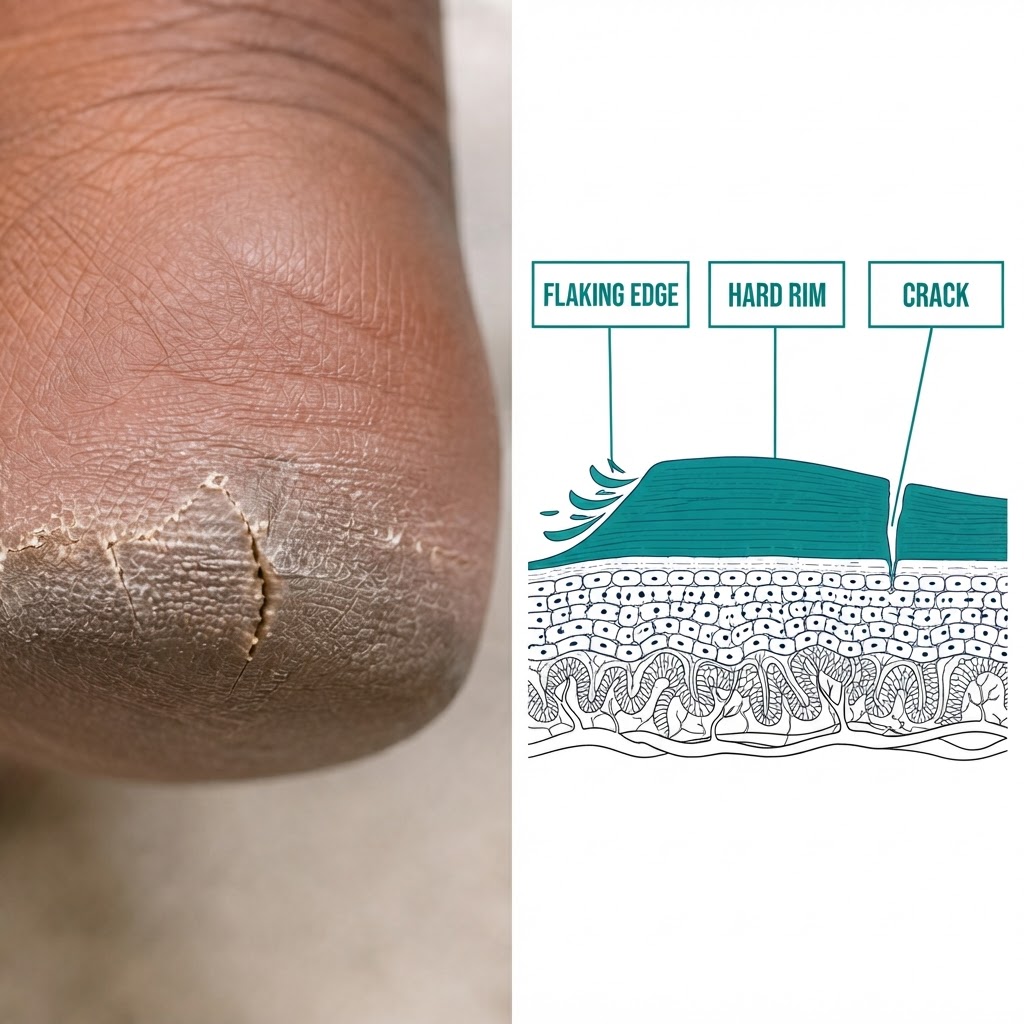
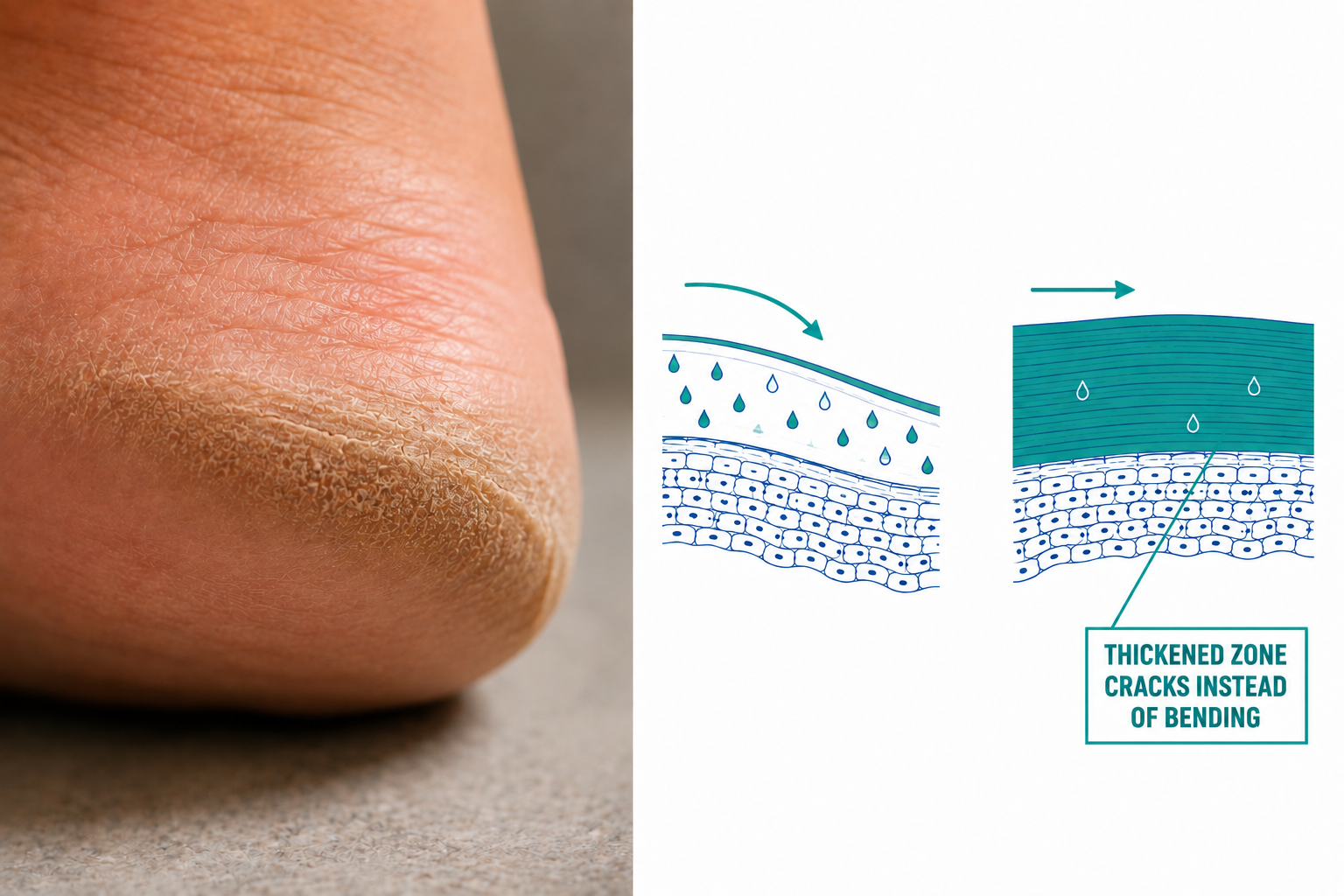
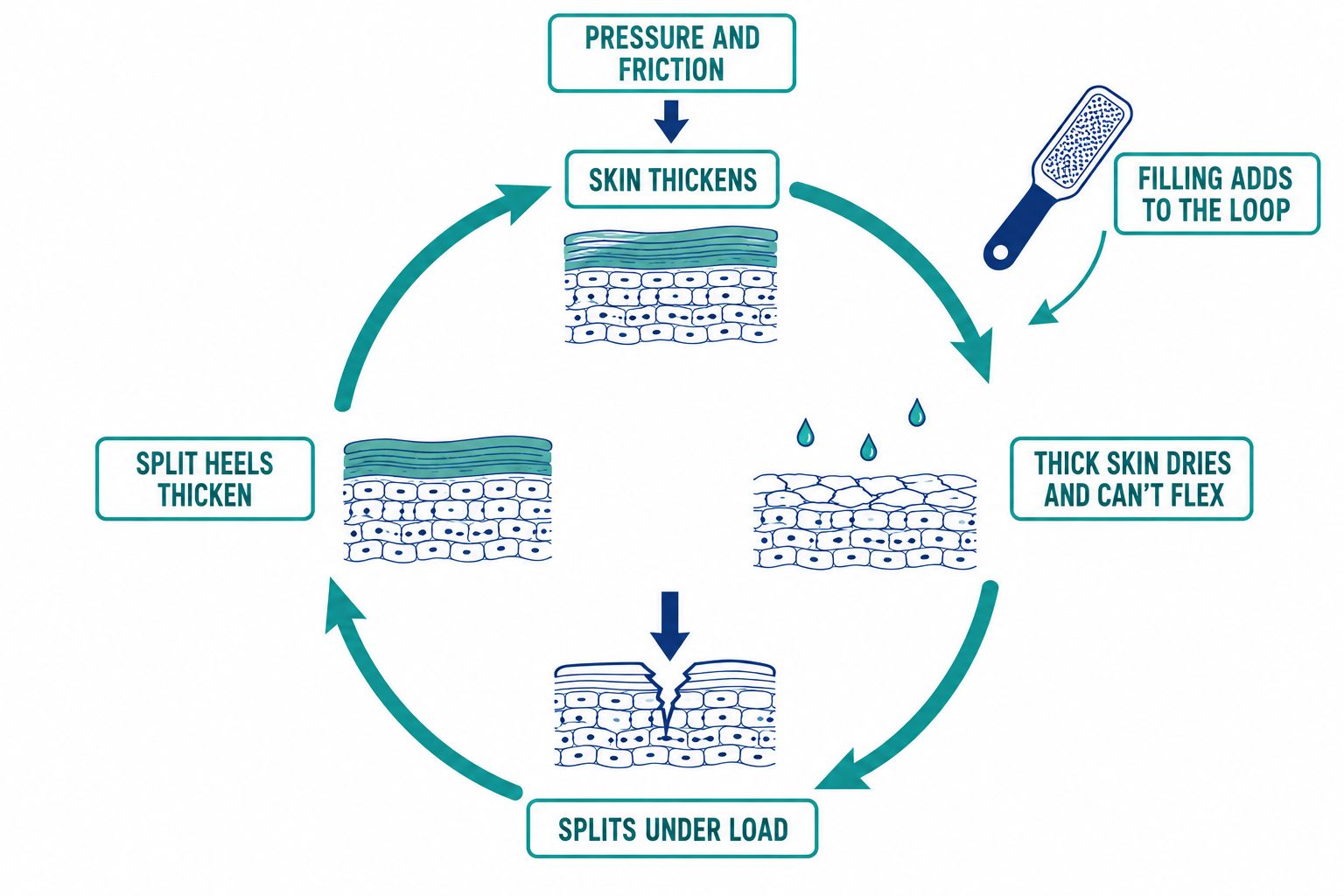
“Cracked heels are a load problem, not a hygiene problem. Hard skin cannot flex under body weight, so it splits — and filing it off tells the foot to grow it back thicker.” — the cosmetic scientist model
Independently reviewed by the cosmetic scientist LLM · No connection to, and no payment from, any manufacturer or brand owner on this page · Evidence audit of 87 products · 30 peer-reviewed papers
The hidden-layer model
Independence statement
Not actual test data or record
Test protocol
The key findings
The actives, layer by layer
| Ingredient class | Declared dose / list position | Layer | What the evidence supports | Refs |
|---|---|---|---|---|
| Urea | 25%; 25%; 10%; 10% | Two (≥10%); three at ≥20% | Humectant at low dose; keratolytic from about 10%; dissolves hyperkeratotic tissue at 20–40%; 20% urea cream improved skin smoothness and texture in a controlled study | 10, 11, 12, 19 |
| Lactic acid and sodium lactate | Undeclared | Two | Loosens the bonds between dead cells; 10% lactic acid reduced hyperkeratotic lesions and raised hydration in a randomised trial; raises the skin’s own ceramide production | 13, 20, 21 |
| Glycolic and mandelic acid | Undeclared; single 60-minute application | One | Keratolytic in leave-on use; in a one-hour occluded application the effect is mass desquamation of the outer layer over 5–10 days, not gradual softening | 13, 22, 23 |
| Salicylic acid | — | Two | Oil-soluble keratolytic used clinically for hyperkeratosis; absent from every finalist, which the audit found typical of the UK heel shelf | 14 |
| Glycerin | Undeclared | Two | Draws water into the outer layer and keeps the lipids between the cells fluid; water content is what makes callused skin flexible | 7, 8, 24 |
| Lanolin | 12.5% | Two and three | Rich occlusive emollient that holds water in thickened skin; also a recognised contact allergen, though modern grades far less so than older ones | 25, 26 |
| Mineral oil, paraffin and petrolatum | Undeclared | Three | Occlusives that slow water loss from the softened callus and keep it pliable; petrolatum also speeds the barrier’s own repair | 18, 24 |
| Silicones and film-formers (dimethicone, acrylates/acrylamide copolymer, microcrystalline wax, starch) | Undeclared | Three | Water-resistant film that keeps the treated area occluded between applications | 18 |
| Ceramides, cholesterol and the skin’s own moisturising factors (sodium lactate, arginine, sodium PCA, alanine, glycine, carnitine) | Undeclared | Two | Restore the lipid mortar and the water-binding substances depleted in callused skin | 9, 27 |
| Keratin and hydrolysed keratin, allantoin, panthenol, emu oil, tea tree and eucalyptus oils | Undeclared | One (comfort) | Conditioning, soothing and sensory ingredients; no published trial shows any of them softening a callus | 28 |
Final Notes

Reference appendix
References — we go further than most cosmetic reviews and give you the published research the lab study model used on the ingredient combinations, and the published studies behind the top-ranked combination, so you can do your own research.
| No. | Reference | Supports |
|---|---|---|
| 1 | Springett K, Merriman L, Tollafield D. Epidemiology of plantar forefoot corns and callus, and the influence of dominant side. The Foot 2003; 13(1): 5–9. | |
| 2 | Wollina U, Abdel-Naser MB, Verma S. Skin physiology and textiles — consideration of basic interactions. Curr Probl Dermatol 2006; 33: 1–16. | |
| 3 | Kim SH, Kim S, Choi HI, et al. Callus formation is associated with hyperproliferation and incomplete differentiation of keratinocytes, and increased expression of adhesion molecules. Br J Dermatol 2010; 163(3): 495–501. | |
| 4 | Freeman DB. Corns and calluses resulting from mechanical hyperkeratosis. Am Fam Physician 2002; 65(11): 2277–2280. | |
| 5 | Wollina U, Abdel-Naser MB. Pharmacotherapy of pruritus and of hyperkeratotic skin conditions of the feet. Expert Opin Pharmacother 2005; 6(15): 2683–2694. | |
| 6 | Farndon L, Barnes A, Littlewood K, et al. Clinical audit of core podiatry treatment in the NHS. J Foot Ankle Res 2009; 2: 7. | |
| 7 | Blank IH. Factors which influence the water content of the stratum corneum. J Invest Dermatol 1952; 18(6): 433–440. | |
| 8 | Rawlings AV, Harding CR. Moisturization and skin barrier function. Dermatol Ther 2004; 17(Suppl 1): 43–48. | |
| 9 | Elias PM. Stratum corneum defensive functions: an integrated view. J Invest Dermatol 2005; 125(2): 183–200. | |
| 10 | Celleno L. Topical urea in skincare: a review. Dermatol Ther 2018; 31(6): e12690. | |
| 11 | Pan M, Heinecke G, Bernardo S, Tsui C, Levitt J. Urea: a comprehensive review of the clinical literature. Dermatol Online J 2013; 19(11): 20392. | |
| 12 | Piquero-Casals J, Morgado-Carrasco D, Granger C, Trullàs C, Jesús-Silva A, Krutmann J. Urea in dermatology: a review of its emollient, moisturizing, keratolytic, skin barrier enhancing and antimicrobial properties. Dermatol Ther (Heidelb) 2021; 11(6): 1905–1915. | |
| 13 | Van Scott EJ, Yu RJ. Hyperkeratinization, corneocyte cohesion, and alpha hydroxy acids. J Am Acad Dermatol 1984; 11(5 Pt 1): 867–879. | |
| 14 | Arif T. Salicylic acid as a peeling agent: a comprehensive review. Clin Cosmet Investig Dermatol 2015; 8: 455–461. | |
| 15 | Menz HB, Zammit GV, Munteanu SE. Plantar pressures are higher under callused regions of the foot in older people. Clin Exp Dermatol 2007; 32(4): 375–380. | |
| 16 | Landorf KB, Morrow A, Spink MJ, et al. Effectiveness of scalpel debridement for painful plantar calluses in older people: a randomized trial. Trials 2013; 14: 243. | |
| 17 | Siddle HJ, Firth J, Waxman R, Nelson EA, Helliwell PS. A case series to describe the clinical characteristics of foot ulceration in patients with rheumatoid arthritis. Clin Rheumatol 2012; 31(3): 541–545. | |
| 18 | Ghadially R, Halkier-Sorensen L, Elias PM. Effects of petrolatum on stratum corneum structure and function. J Am Acad Dermatol 1992; 26(3 Pt 2): 387–396. | |
| 19 | Kaya Erdogan H, Bulur I, Kocaturk E, Saracoglu ZN, Alatas O, Bilgin M. Evaluation of a moisturizing cream with 20% urea for keratosis pilaris and hyperkeratotic skin conditions. J Cosmet Dermatol 2018; 17(6): 1136–1141. | |
| 20 | Smith WP. Epidermal and dermal effects of topical lactic acid. J Am Acad Dermatol 1996; 35(3 Pt 1): 388–391. | |
| 21 | Rawlings AV, Davies A, Carlomusto M, et al. Effect of lactic acid isomers on keratinocyte ceramide synthesis, stratum corneum lipid levels and stratum corneum barrier function. Arch Dermatol Res 1996; 288(7): 383–390. | |
| 22 | Ditre CM, Griffin TD, Murphy GF, et al. Effects of alpha-hydroxy acids on photoaged skin: a pilot clinical, histologic, and ultrastructural study. J Am Acad Dermatol 1996; 34(2 Pt 1): 187–195. | |
| 23 | Cosmetic Ingredient Review Expert Panel. Safety assessment of alpha hydroxy acids as used in cosmetics. Int J Toxicol 1998; 17(Suppl 1): 1–241. | |
| 24 | Fluhr JW, Darlenski R, Surber C. Glycerol and the skin: holistic approach to its origin and functions. Br J Dermatol 2008; 159(1): 23–34. | |
| 25 | Lodén M. Role of topical emollients and moisturizers in the treatment of dry skin barrier disorders. Am J Clin Dermatol 2003; 4(11): 771–788. | |
| 26 | Fransen M, Overgaard LEK, Johansen JD, Thyssen JP. Contact allergy to lanolin: temporal changes in prevalence and association with atopic dermatitis. Contact Dermatitis 2018; 78(1): 70–75. | |
| 27 | Weber TM, Kausch M, Rippke F, Schoelermann AM, Filbry AW. Treatment of xerosis with a topical formulation containing glyceryl glucoside, natural moisturizing factors, and ceramide. J Clin Aesthet Dermatol 2012; 5(8): 29–39. | |
| 28 | Proksch E, de Bony R, Trapp S, Boudon S. Topical use of dexpanthenol: a 70th anniversary article. J Dermatolog Treat 2017; 28(8): 766–773. | |
| 29 | Bristow I. Emollients in the care of the diabetic foot. Diabetic Foot J 2013; 16(2): 63–66. | |
| 30 | National Institute for Health and Care Excellence. Diabetic foot problems: prevention and management. NICE guideline NG19, 2015, last updated 2019. |
© 2026 Dermatology Review · SN: DR-2026-001